
The Mount Washington Cog Railway was the world's first mountain-climbing cog railway. More than 150 years later, it still pushes passengers three miles up the mountain's western slope to the summit.
An ordinary train can't climb a grade this steep, because its wheels would slip on the rails. A cog railway solves that with a toothed rack laid between the rails. A gear under the locomotive meshes with the rack and pulls the train up, and on the way down the gear holds the train back.
"Marsh's railway to the moon"
The railway was the idea of Sylvester Marsh, who grew up in Campton, New Hampshire. Legend has it that when he asked the state legislature for a charter, one lawmaker joked that he might as well be given permission to build a railway to the moon. The charter was granted on June 25, 1858, but the Civil War delayed construction until 1866.
The first paying passengers rode part of the way up on August 14, 1868, and the line reached the summit on July 3, 1869. Marsh designed his own rack system, with open, ladder-like rungs that let snow and debris fall through. The Marsh rack is still in use today.
- 1858The New Hampshire Legislature grants Marsh's charter.
- 1866Construction begins after the Civil War.
- 1868First paying passengers ride the lower part of the line.
- 1869The railway reaches the summit.
- 1910Locomotives switch from burning wood to coal.
- 1929The original locomotive, Old Peppersass, derails on a commemorative run, killing a photographer.
- 1962Named a National Historic Mechanical and Civil Engineering Landmark.
- 1967A derailment near the summit kills eight passengers and injures 72.
- 2008The first biodiesel locomotive enters service.
The locomotives
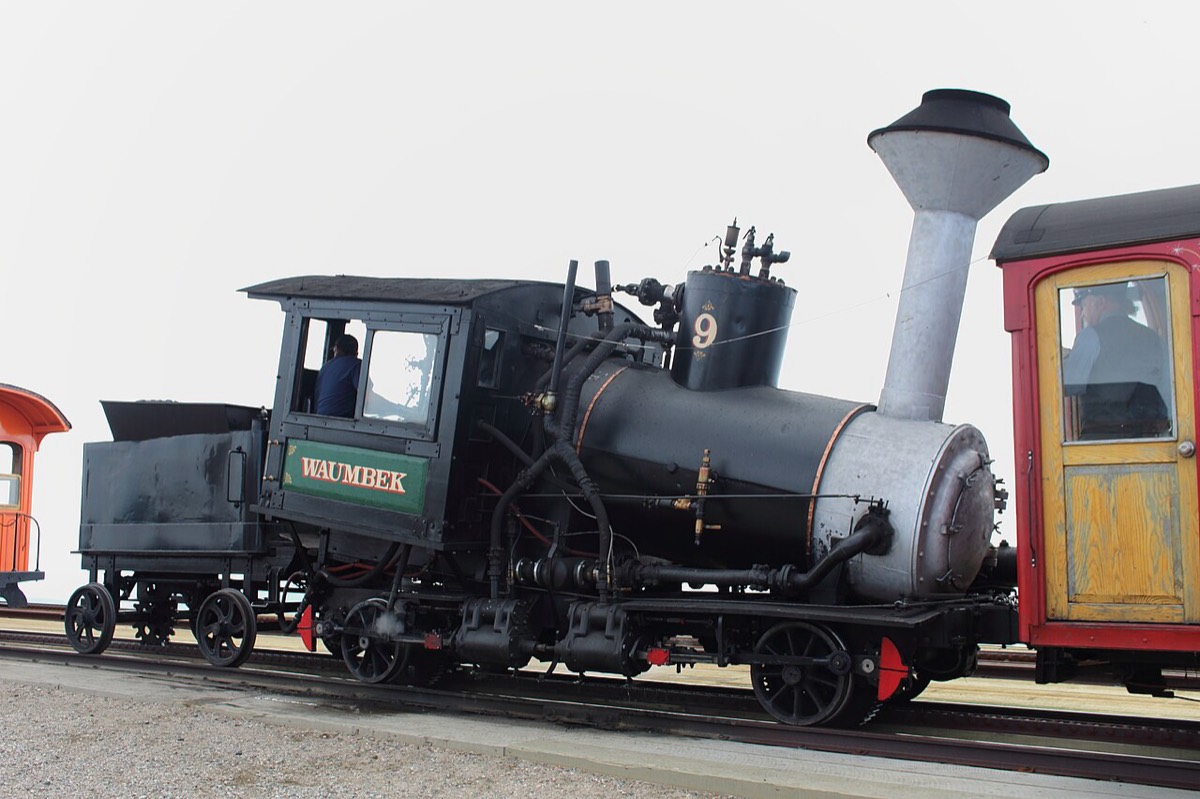
The steam locomotives look strangely tilted when they sit on level track at the base. Their boilers are mounted at an angle so that on the steep grade they stay nearly level, keeping water over the firebox. Each engine pushes a single passenger car up the mountain from below.
The climb is slow: about 2.8 mph going up and 4.6 mph coming down. A steam trip takes about 65 minutes up and 40 minutes down. Since 2008 the railway has also run biodiesel locomotives, which can make the climb in as little as 36 minutes. The first was named Wajo Nanatassis.
The line's best-known landmark is Jacob's Ladder, a tall trestle high on the mountain where the track climbs one of its steepest stretches.

The "devil's shingles"
Railway workers once had a much faster way down. They built small wooden slideboards, about 35 inches long and 10 inches wide, that fit over the rack, and rode them down the mountain. A typical descent took about 15 minutes, and the record was 2 minutes and 45 seconds. The boards, nicknamed "devil's shingles," were banned in 1908 after a worker was killed.
Riding the railway: Trains leave from the Base Station off Route 302, near Bretton Woods. Schedules, prices, and seasonal service change from year to year, so check the Mount Washington Cog Railway before you go.